

How Convoy Became San Diego’s Karaoke Capital
Terry King doesn’t sing. He’ll tell you himself.
King first started working at Min Sok Chon, a Korean-style karaoke bar on Convoy Street, as a security guard 19 years ago. Today, he’s a dual guard-host; but when I ask for his go-to karaoke song, it takes him a few minutes before admitting that it’s Queen’s “Bohemian Rhapsody.”
“I like the high notes, but I can’t hit them,” King says. He says a lot of guests start their nights at Min Sok Chon with similar protestations.
It’s a Thursday night, and the restaurant is crowded and getting more so. Min Sok Chon means “folk village” in Korean, and sits in a strip mall a few storefronts from Somisomi, a dessert shop in the middle of Convoy Street.
Min Sok Chon is one of several karaoke spots in Convoy, San Diego’s hub of Asian restaurants, markets, and shots. Some have private rooms for friends; others put you in front of a bar full of strangers. Either way, being able to sing is beside the point.
King arrived on a security contract, and when it ran out, his boss kept him on. He stood by the door and already knew the customers, so on busy nights, he started handing out buzzers and menus himself.
“When I first started working here, it was like 95 percent Asian,” he says. Now it’s all walks of life. People he met in their 30s now have grown children who come in on their own.
One such kid is Noe Gonzalez, a Min Sok Chon server who, as King put it, grew up here. Gonzalez’s dad worked nearby around 2008—when Gonzalez was around 8—and brought him in on breaks. He joined the staff in 2021 and tonight, he’s our server.
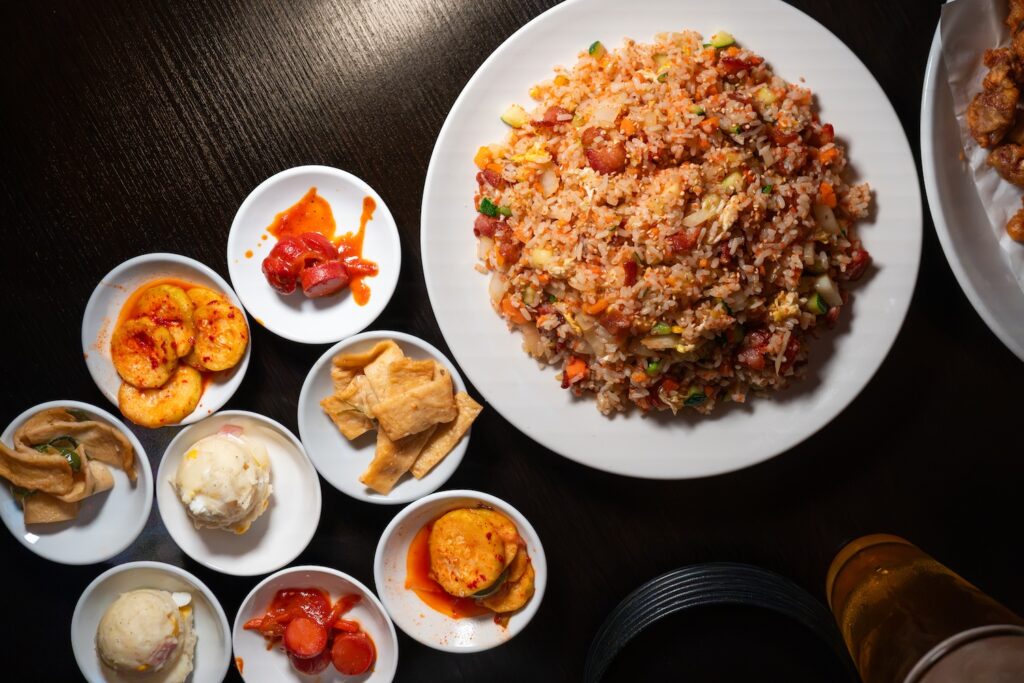
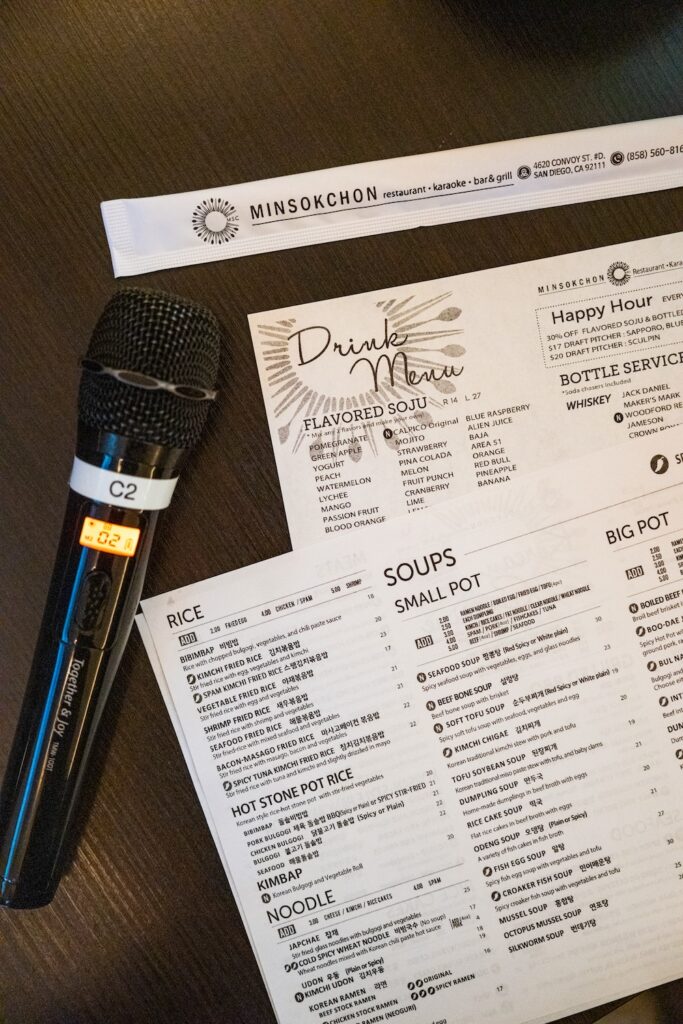
Our room has two thick songbooks, a delight in an algorithmic era. We order deep-fried gizzards and fried rice, and I settle in on a Sapporo. When Gonzalez says the large lychee soju comes to about a liter, we order the large.
Gonzalez mentions that the restaurant replaced its whole karaoke system last summer, which meant new pages for every book. He put them in himself. “I believe it took me probably a whole shift,” he says.
Min Sok Chon gets music from Karaoke Vision, a Los Angeles company whose technicians come down every three months to load new music and check the equipment, co-owner Youn-Joo (who prefers to keep her full name private) says. The dining hall and the five private karaoke rooms were already here, she tells me, and she thinks the previous owner built them around a familiar routine of Korean corporate outings: the first round of the night happens at a restaurant and the second at a karaoke room.
Karaoke originated in Japan. Engineer Shigeichi Negishi built an early machine in 1967; businessman Daisuke Inoue began renting his own machine to bars in 1971. By the early 1990s, South Korea’s rented singing rooms, called noraebang, were taking off—a history that Ji Hyun Moon explored in The Korean Journal of Cultural Sociology. As karaoke spread to the US and Europe, it became popular in bars, with one machine and one sign-up list.
For Youn-Joo, the impulse to sing together goes back much further than karaoke. Youn-Joo recalls the Records of the Three Kingdoms, a Chinese history spanning the end of the Han and the beginning of the Jin dynasties. It includes accounts of singing and dancing in ancient Korean kingdoms. “The people love singing and dancing,” Youn-Joo remembers of the histories. “When night falls, every village across the land gathers in groups to sing and enjoy games together.”
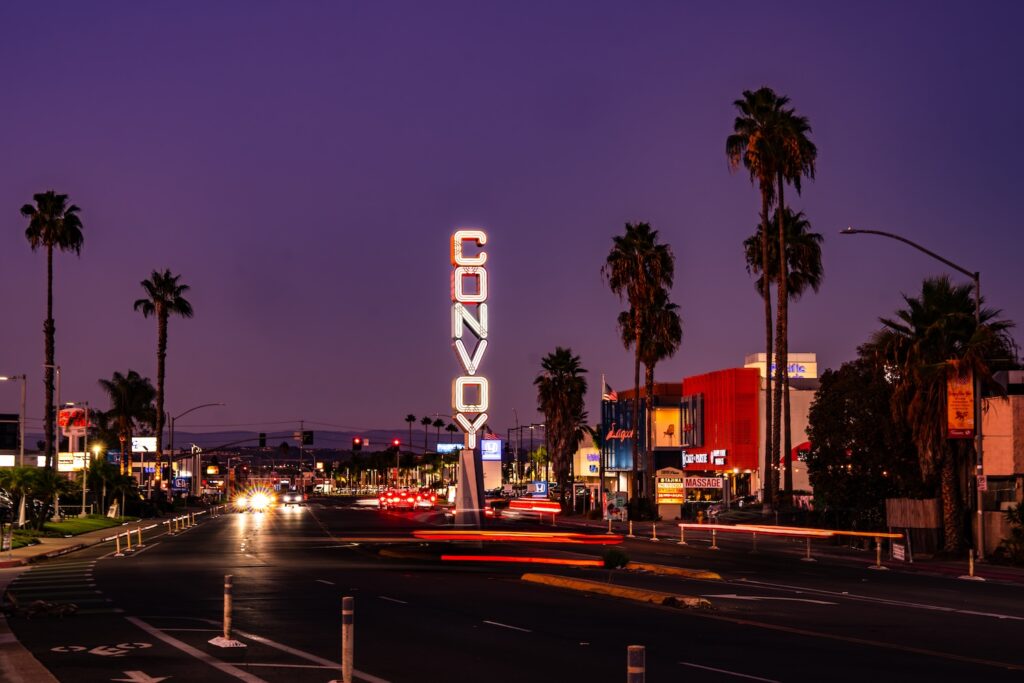
Convoy’s Asian food scene began taking shape in the late ’70s. Woo Chee Chong opened a grocery store on Convoy Street in 1979. Asian immigrants added restaurants, markets, and other businesses through the ’80s and ’90s. In 2020, the city officially recognized the area as the Convoy Pan Asian Cultural and Business Innovation District. As Asian families and businesses gathered in Convoy, their cultural traditions followed, including after-work activities like karaoke.
Today, Convoy has both kinds of karaoke. Carriage House does it the more public way. Music Studio Jin, in the same plaza, is San Diego’s first Asian-style karaoke bar and has private rooms. Geun-Young and Kyung-Mi Jin—who left Jecheon, South Korea, for San Diego in 1986—opened their business in 1996, according to interviews published by the Alliance of Chinese Americans San Diego.
In those interviews, the Jins describe music as a source of reassurance through hard times. They opened the business to share the comfort and a part of their Korean culture.
At Music Studio Jin, the karaoke machines come from South Korea, so each room has a translation of the Korean remote taped to the wall. By the time Music Studio Jin opened, San Diego had already had a karaoke presence at the Stage Door Bar near Crystal Pier in Pacific Beach. The Sciuto family ran Western-style karaoke nights until 1993, before karaoke took off at their other bar, The Lamplighter in Mission Hills.
When Min Sok Chon opened in 2003, it had a mostly Korean crowd, Youn-Joo says, many of them corporate expats and students. Her husband—who took over operations when he was 30—switched the playlist to hip-hop and came up with flavored soju cocktails to bring in local twentysomethings, who otherwise didn’t have many places on Convoy to hang out. (Convoy was still a mix of auto-repair shops and industrial businesses, and places to eat and drink.) King calls those rowdy years “the Tupac era.” Youn-Joo recently came across a Reddit reply about Min Sok Chon that made her laugh: “Oh my god, I spent most of my 20s in that place!”
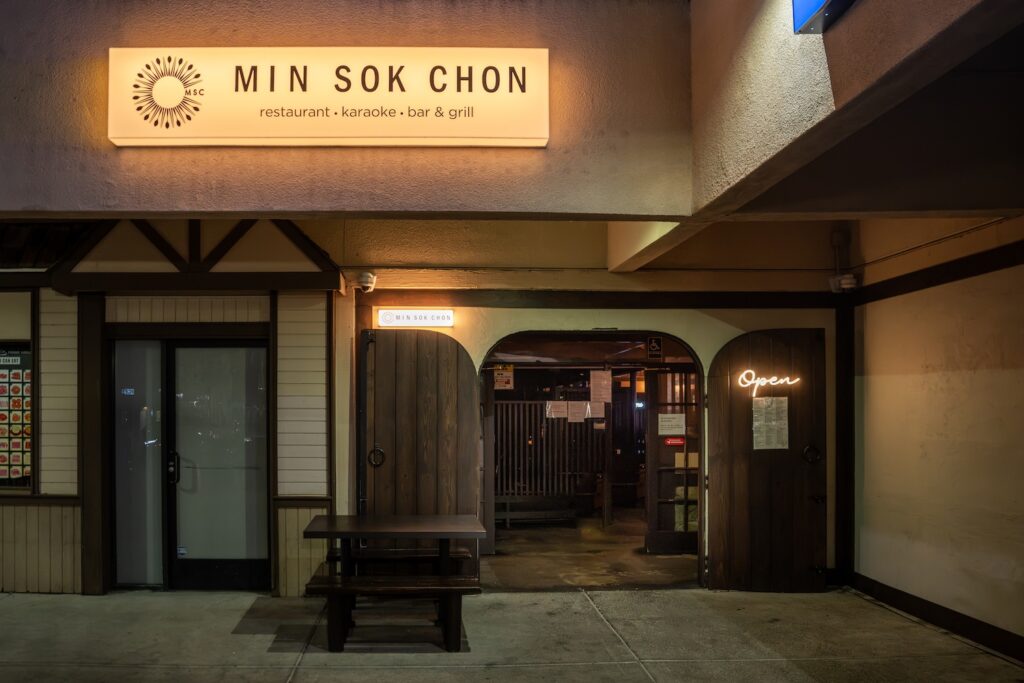
Catherine Peng, 35, the director of operations at Kingfisher, spent some of hers here. She moved from the Bay Area for UCSD in 2009, and Min Sok Chon became her college late-night spot because it had food and, as she remembers it, one of the only full liquor licenses around. Korean karaoke places became the default hangout spot at that time, Youn-Joo says, because Convoy was one one of the few places in San Diego where you can let loose and get great food. (Min Sok Chon made it easy to do both: Its food is made from scratch, in-house.)
Wherever Peng goes, she wants the queue full and everyone singing backup. “The crew is everything,” she tells me. “It doesn’t matter if there are 20 people or just two.” She also doesn’t care who can sing: “If you’re putting your heart into it, I want you there.”
She loves finding out that the nice, quiet girl knows every word of Eminem’s “Lose Yourself.” “You suddenly become best friends with whoever is in the room as you sing your favorite songs together,” she says. Media scholar Anthony Fung noticed the same effect when he joined karaoke gatherings of friends, relatives, and colleagues in Hong Kong and mainland China for a study published in the winter 2009–10 issue of Chinese Sociology & Anthropology. He argued that revealing your individuality while singing can build “trust and connectedness within the group.”
Peng already knew karaoke from home. Her parents threw big house parties that always ended up at the LaserDisc machine and its collection of old Chinese songs. The videos showed women with huge ’80s hair, or people working in a field while singing folk songs. Her parents and their friends sang loudly into cheap mics with far too much reverb while she watched with secondhand embarrassment, and after bedtime, the music kept blasting downstairs and kept her awake.
These days, she picks her karaoke room by the kind of night she wants to have. Music Studio Jin is for the spur-of-the-moment decision after dinner, because she can walk in at 10 p.m. and still have the whole night to sing. Melody Karaoke and Cafe is the more luxurious outing and reminds her of KTVs (private karaoke rooms) in China.
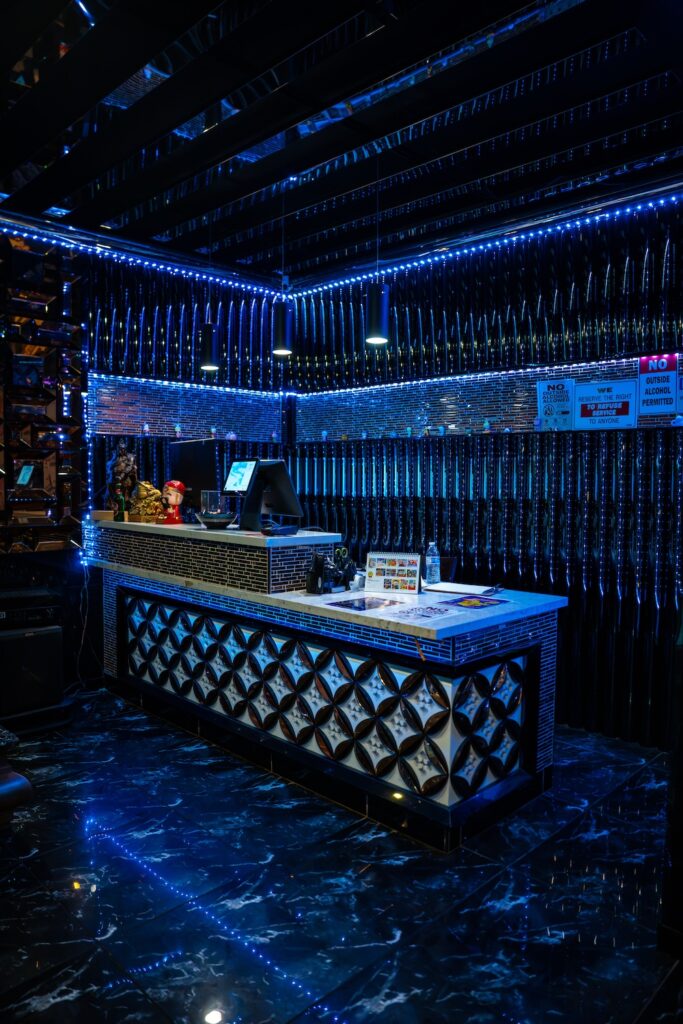
We also go to Melody on our night out, and it’s a KTV far more gilded than Min Sok Chon, with mirrored hallways. It smells like the walls are made of sanitizer, but Peng tells me it isn’t always like that.
Tonight, we sing. I queue Michael Bolton’s “Said I Loved You… But I Lied.” Someone plays “Save Tonight” on the theory that it is the crowd closer nobody expects anymore after so many years in play. We are thrilled. There’s a lot of Linkin Park and the requisite Frank Sinatra “My Way.” My standby is “Papa Don’t Preach,” and I sing it every time, but this time, I’m rusty. I blame it on the recent humidity.
These days, most of Min Sok Chon’s customers are not Korean, Youn-Joo says. Koreans who live in San Diego or come through for conferences still eat here and perform Korean songs, which is why she expects to keep a Korean machine even if the books give way to iPads someday. “There’s still a distinct joy in flipping through a thick songbook and finally finding the title you’re looking for,” she says.
Some of those early customers now have children who come into Min Sok Chon to drink and sing, just like their parents, Youn-Joo says. “Rather than saying our customer base has changed, it’s more accurate to say we are growing older together,” she says.
Youn-Joo thinks about it through nostalgia. As a child, her family took her to the buffet at the Grand Hyatt on Namsan in Seoul for special occasions. She went back with college friends and later for company dinners. The hotel even had karaoke rooms 20 years ago. It is old now and well kept, and every time she goes back, the memories rush in. She wants Min Sok Chon to do the same for the people who grew up there. Customers who return after years away tell her, “This place is just like it used to be.”
King has heard it all from the door. His own music is jazz, and he’s a drummer who used to play with a Chula Vista reggae band called Bredren. He has worked security all over San Diego, and this is the job he kept. “Right here is home,” he says. “I fell in love right here.”
The post How Convoy Became San Diego’s Karaoke Capital appeared first on San Diego Magazine.
Categories
Recent Posts









GET MORE INFORMATION